Trending
Three women in 19-man presidential race expose Nigeria’s deep gender gap
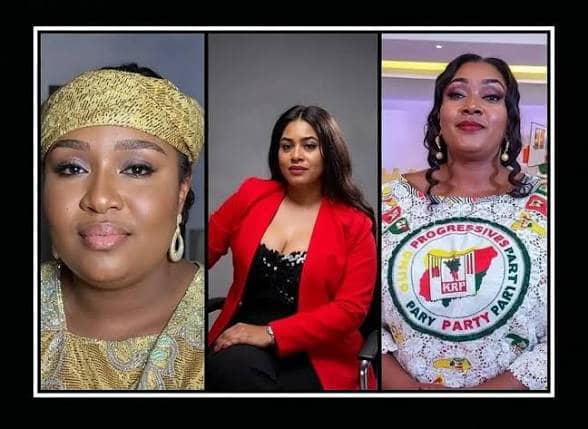
As Nigeria prepares for the 2027 presidential election, only three women are among the 19 candidates listed for the country’s highest elective office, highlighting the persistent exclusion of women from political leadership.
The Independent National Electoral Commission (INEC) has released the names of the presidential candidates for 2027. However, 3 out of 19 candidates, which constitutes 16 percent of the total candidates, are women despite making up 49.32 per cent of Nigeria’s population.
The three women are Ada Elizabeth Okwori of the National Democratic Party (NDP), Anita Zugwai Chukwu of the Young Progressives Party (YPP), and Esther Iken Okereke of the National Rescue Movement (NRM).
Also, there are three female vice-presidential candidates who will be contesting. These are: Samuel Maddalene Gali (NRM), Konto Hajja Bintu (LP), and Ofordile Peace Egobia (APP).
They are up against 16 men, including President Bola Tinubu of the All Progressives Congress (APC), former Vice President Atiku Abubakar of the African Democratic Congress (ADC), Peter Obi of the Nigeria Democratic Congress (NDC), and other candidates across the political.
The figure reflects a pattern in Nigerian politics in which women participate extensively in elections but remain largely absent from the institutions where political decisions are made.
Data from 2015 show that only one woman contested the presidency, while four women were listed as vice-presidential candidates, with 14 political parties participating.
By 2019, female participation had increased, with five women contesting the presidency and 23 contesting the vice-presidency, as the number of political parties also rose to 72.
In the 2023 election, only one woman contested for the presidency while no woman contested for the vice-presidency. The number of participating political parties also dropped to 18.
Since the return to democratic rule in 1999, there has been underrepresentation of women in the parliament.
For instance, in the 10th National Assembly, women account for only about 3.7 per cent of senators and 4.4 per cent of members of the House of Representatives.
Fourteen state assemblies do not have a single woman. The states are Kaduna, Kebbi, Sokoto, Zamfara, Jigawa, Kano, Bauchi, Gombe, Yobe and Plateau.
A system that shuts women out
Women's political underrepresentation is driven by several structural barriers, including party gatekeeping, the high cost of elections, political violence, patronage networks and social expectations around women's roles.
Nigeria's political system is heavily dependent on financial resources and networks built over years. Meanwhile, women who lack comparable access can struggle to compete even when they have the qualifications and political ambition.
Also, women seeking political office can face expectations and scrutiny that their male counterparts often do not encounter to the same extent. Their marital status, appearance, family responsibilities, age and personal lives can become subjects of political attacks.
Women in politics also face harassment and gender-based abuse, including attacks on social media. Such hostility can discourage women from contesting elections and can make political office a particularly costly pursuit.
The result is a cycle in which fewer women reach elected office, leaving fewer women with the political experience, networks and visibility required to compete for higher positions.
Meanwhile, the scale of the imbalance has also been recognised internationally.
Data from the Inter-Parliamentary Union's 2023 placed Nigeria among the 10 countries with the lowest levels of women's representation in national parliaments worldwide.
The World Economic Forum's 2025 Global Gender Gap Report similarly ranked Nigeria 143rd out of 144 countries for women's political participation.
However, the Revised National Gender Policy 2021-2026 adopted a 35 per cent affirmative-action target for women's participation in political and public decision-making, in line with Nigeria's obligations under international frameworks.
This is yet to be achieved as women representation still falls short 35 percent.
The Special Seats proposal
The Reserved Seat bill is a constitutional amendment legislation seeking to create additional elective seats exclusively for women in the Senate, House of Representatives, and State Houses of Assembly.
It seeks to create additional constitutionally recognised seats strictly for women. In the Senate, each state and the FCT would have one extra seat reserved exclusively for women.
Also, the House of Representatives will have one extra seat for each state and the FCT. At the state level, each House of Assembly would add three women-only seats.
However, this bill is yet to become law. If passed, Nigeria’s legislature would expand to 146 senators, 397 members of the House, and 1,098 state legislators.
The reserved seats would offer equal status, powers, and privileges as the existing seats, and women occupying them would not be barred from contesting regular seats.
Women deserve more than 35%
The Minister of Women Affairs and Social Development, Hajiya Imaan Sulaiman-Ibrahim, has urged Nigerian women to move beyond the existing 35 per cent affirmative-action benchmark and push for equal representation in political leadership.
She made the call on Wednesday in Jalingo, Taraba State, while speaking to participants at the 26th National Council on Women Affairs and Social Development.
The minister said women should now demand 50-50 representation and intensify efforts to secure greater political and economic influence.
According to her, the 35 per cent affirmative-action provision contained in Nigeria’s laws and policy frameworks had not produced the level of representation expected in elective and appointive positions.
She argued that the time had come for women to shift from seeking limited affirmative action to demanding parity in political participation.
“We don’t want 35 per cent anymore. We want 50-50,” she said.
Sulaiman-Ibrahim also linked women’s economic empowerment to their participation in politics, saying women must have meaningful representation in institutions responsible for making policies and decisions that affect their lives.
She identified inadequate funding as one of the major obstacles limiting women’s ability to compete effectively in elections. To address the challenge, she proposed the creation of a women’s political trust fund to help reduce the financial burden of contesting elections.
The minister stressed that increasing the number of female candidates alone would not be sufficient, arguing that women seeking elective office must also be adequately prepared to compete.
“It is not enough to have women contesting. Women must know what they are contesting for. They must be very, very strong so that they can stand to compete,” she said.
She further advocated the deliberate development of a pipeline of female political leaders through sustained training, mentorship and capacity-building initiatives.
However, the minister cautioned against portraying men as the primary impediment to women’s advancement in politics.
She urged women to regard male politicians, traditional rulers, religious leaders and other influential figures as partners in the campaign for gender equality, rather than adversaries.