Trending
Average Salary of an Urban Planner in Lagos State, Nigeria
Average Salary of an Urban Planner in Lagos State, Nigeria 2022
How much money do urban planners working in Lagos, Nigeria, make?
A comprehensive survey was conducted among urban planning professionals in Lagos, Nigeria, and hundreds of responses were gathered. Further details on the findings are shared in this post.
All salary figures displayed here are per month except when noted otherwise.
All salary and compensation figures displayed here are gross salary figures, that is, the salary before tax deductions. Because taxes may differ across organisations and locations, accurately calculating the net salary after tax is complex.
An urban planner working in Lagos, Nigeria, typically earns around 113,000 NGN. Salaries range from 64,000 NGN (lowest average) to 205,000 NGN (highest average).
Pay Scale and Salaries of Urban Planners in Lagos, Nigeria
Salary Structure and Pay Scale Comparison
Median Salary, maximum and minimum salary, minimum wage, starting salary, and the salary range in Nigeria
Salary Range, Minimum Wage, and Starting Salary
- Urban Planners' Salaries in Lagos, Nigeria, range from 64,000 NGN (starting salary) to 205,000 NGN (maximum average salary). This is not the minimum wage per the law; it is the lowest reported number in the salary survey, with hundreds of participants and professionals from Lagos, Nigeria.
- Median Salary
The median salary is 113,000 NGN, which means that 50% of the urban planning professionals in Nigeria earn less than that, while the other half earn more. The median represents the middle salary value. Generally speaking, you would want to be on the right side of the graph with the group earning more than the median salary.
● Percentiles and Salary Scale
Two values are closely related to the median: the 25th and 75th percentiles. According to the salary distribution diagram, 25% of the urban planner population in Lagos earns less than 81,000 NGN, and 75% earn less than 162,000 NGN.
● Pay Scale Structure
We grouped the most common and recurring salaries into brackets to give more insight into what salary to expect. This method is more accurate than just the average salary and gives more insights into how urban planners' salaries are distributed in Lagos, Nigeria. Around 65% of all reported figures are in the range of 75,000 NGN to 138,000 NGN. Approximately 20% fall under the 75,000 NGN cap. 10% of wages are from 177,000 NGN to 190,000 NGN. Only 5% of people grossed 190,000 NGN or more.
Salary Comparison by Years of Experience
How does an urban planner’s salary progress over time?
Salary is primarily determined by the level of experience one possesses, with higher levels of experience resulting in higher wages.
In Lagos, Nigeria, employees with two to five years of experience typically earn an average of 25% more than entry-level and junior workers. This group can be found mostly in the 25% to 50% quartiles.
Individuals with more than five years of experience earn an average of 15% more than those with less than five years of experience. This group is mostly found in the 50% to 75% quartiles.
Between ten and fifteen years of work, salaries increase by 20%, and after fifteen years of work, salaries increase by 15%, with an additional 10% increase for those who have worked for over 20 years. Depending on the company's salary structure, these groups can be found primarily in the 75% to 100% quartiles.
These figures should be used as rough estimates, as considering individual job descriptions and organizations can lead to more accurate assessments.
Changes in salary based on experience vary drastically from one location to another and depend hugely on organisations/companies. The data displayed here is the combined average of regional organisations/companies in Lagos State, Nigeria.
Salary Comparison By Education
How does the education level affect your salary?
Change in salary based on education is highly revered in the field of urban planning in Nigeria. The data displayed here is the combined average of multiple companies situated in Lagos, which is the highest-paying region in Nigeria.
The correlation between higher education and higher salary is widely acknowledged, but how much of an income increase can one expect from obtaining a degree?
We conducted a study in Lagos, Nigeria, comparing the salaries of urban planning professionals with different levels of college degrees who held similar positions in various industries.
Our results showed that individuals with a certificate or diploma earned an average of 17% more than those who only completed high school.
Those who obtained a Bachelor's Degree earned 24% more than their counterparts with a certificate or diploma.
Professionals with a Master's Degree earned 29% more than those with a Bachelor's Degree.
Finally, those who held a PhD earned an average of 23% more than those with a Master's Degree while performing the same job.
Salary and Compensation Comparison By Gender / Nigeria
While gender should ideally not influence pay, the reality is often different. In Nigeria, men, on average, earn about 7% more than women in various professions, including urban planning.
Average Annual Salary Increment Percentage of Urban Planners in Lagos, Nigeria
How much are annual salary increments in Lagos, Nigeria for Urban Planners? How often do employees get salary raises?
Nigeria
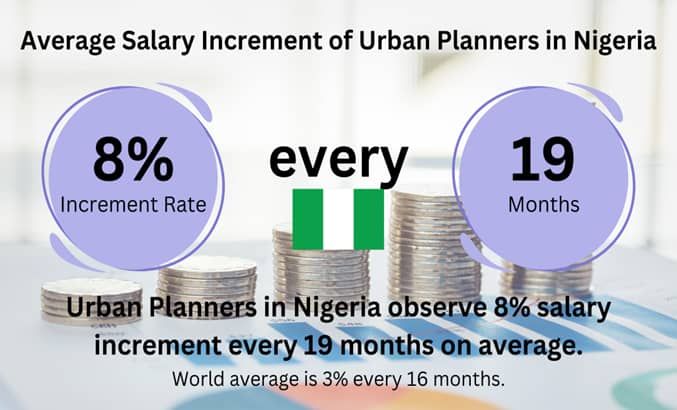
In Lagos, employees typically experience a salary increase averaging 8% every 19 months, a trend that applies to urban planning professionals.
The figures presented here represent average values and should be considered as general benchmarks. Salary increases vary for individuals based on numerous factors. However, performance and contributions to organizational success are the most significant determinants of the frequency and amount of raises.
The term "Annual Salary Increase" typically refers to a raise within a 12-month period. However, since salary reviews rarely occur precisely at the one-year mark, it is more practical to consider both the rate of increase and the frequency with which it occurs.
Worldwide Salary Raises: All Countries and All Jobs
Salary Packages and Schemes
Not all compensation increases are reflected directly in the salary. Some companies offer upgraded packages to their staff instead of cash money. The figures displayed here account only for direct increments to the base salary.
Bonus and Incentive Rates in Lagos, Nigeria
How much and how often are bonuses being awarded?
51% of surveyed employees reported not receiving any bonuses or incentives in the previous year, while 49% said they received at least one monetary bonus.
Those who got bonuses reported rates ranging from 3% to 6% of their annual salary.
Types of Bonuses Considered
Individual Performance-Based Bonuses
The most standard form of bonus is one in which the employee is awarded based on their exceptional performance.
Company Performance Bonuses
Occasionally, companies share surplus earnings and profits with their employees through collective bonuses. The bonus amounts, however, often vary based on an individual's organizational role and impact.
Goal-Based Bonuses
Granted upon achieving an important goal or milestone.
Holiday / End of Year Bonuses
These bonuses are typically given as a gesture of appreciation and are not tied to any specific performance metric or occasion.
Bonuses Are Not Commissions!
Bonuses and commissions are often misunderstood as the same, but they differ significantly. A commission is a predetermined percentage earned based on sales or completed deals, while a bonus is typically discretionary and unplanned.
Bonus Rates Comparison by Career Field
What makes a position worthy of good bonuses and a high salary?
Revenue-generating employees typically receive higher salaries, larger bonuses, and more frequent salary increases. This is because their contributions to the company’s financial success are more easily quantified in monetary terms.
Bonus Comparison by Seniority Level
Top management and senior employees generally receive higher bonuses, both in terms of amount and frequency, due to the greater responsibilities associated with their positions. It is not uncommon for those in higher roles to earn bonuses that are double or even triple the rates of employees lower in the organizational hierarchy.